
1-Car Garage Cost with Concrete Slab: What You Should Budget
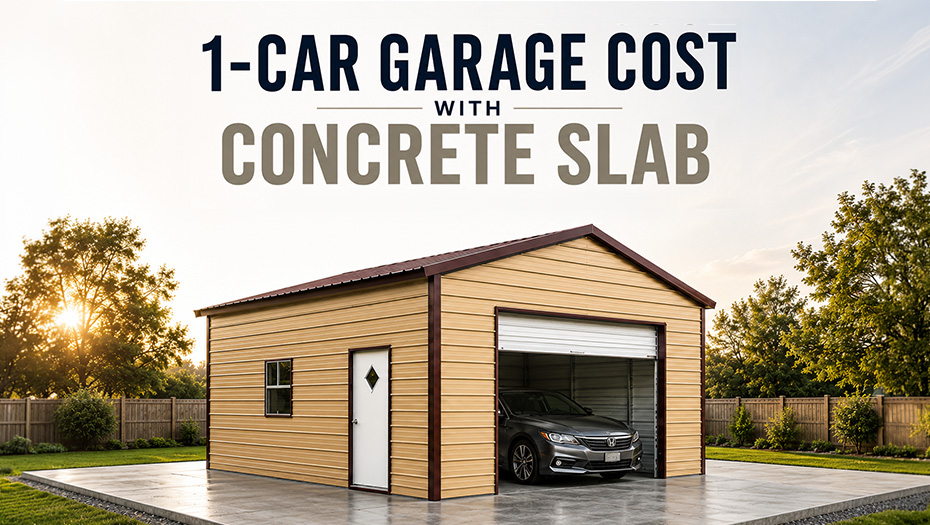
A one-car garage sounds simple on paper. But when people start pricing one out, they usually look at the structure first. The walls, roof, and doors. The slab underneath, however. That’s where budgets quietly drift.
If you’re trying to get a realistic number for a one-car garage with a concrete slab, most projects end up somewhere between about $10,500 and $27,000. A lot of builds settle in the low 20s, but that number moves around. And a big reason is the slab.
Your foundation is not just a line item. It can easily swing the total depending on what your site looks like before anyone even shows up with concrete.
What Size Is a “Normal” 1-Car Garage?
There isn’t one exact size, but most fall somewhere in that 240 to 384 square foot range.
You’ll see dimensions like:
A 12x20 works if all you care about is getting a car inside and out of the weather. That’s about it. The moment you want shelves, a workbench, or even just space to open your door without thinking about it, it starts to feel tight.
That’s why people often bump the size up a bit. Just a couple extra feet in width or depth can make the space feel completely different. And it’s usually cheaper to do that upfront than wish you had later.
What Does the Concrete Slab Really Cost?
Most basic slabs fall somewhere around $4 to $8 per square foot. Garage slabs tend to creep higher, between $6 to $12 per square foot, because they’re built to handle vehicle weight and usually need a bit more structure.
So in real terms:
A 12x20 slab (240 sq ft) might land around $1,400 to $2,800
A larger 384 sq ft slab could run roughly $2,300 to $4,600
That’s not including any framing reinforcements or weather-related upgrades. In fact, two people can build almost the same garage and still get very different slab quotes for these reasons.
What Actually Pushes the Total Price Up?
Size is one of the obvious factors in metal building prices. The larger the garage, the more money it will cost. Materials make a difference too. Upgraded finishes, insulated doors, electrical and plumbing can all add up in layers.
Then there’s whether the garage is attached or detached. Attached usually costs a bit less since it can share parts of the structure and utilities.
Location, permit requirements, even how easy it is to access your property, all of that shows up in the final number.
And then you’ve got the site itself. Those are the kinds of costs that don’t show up in “starting at” prices online, but they’re very real when the project begins.
A Rough Way to Think About Budget
Most one-car garage projects tend to fall into a few loose categories.
Basic build
A basic garage will be smaller with simple finishes and minimal site work. You might land somewhere around $10,500 to $16,000.
Mid-Tier
This garage is a bit larger with standard materials and typical conditions. Usually around $18,000 to $23,000.
More customized
Bigger footprint, upgraded materials, maybe insulation or extra features. Costs can climb toward $27,000 or more.
Don’t just compare the building price. You’ll still need to factor in site prep, permitting, foundation work, and more before coming to an accurate project cost.
Is the Slab Worth It?
Yes, in most cases. A garage without a proper slab just doesn’t hold up the same way. The concrete gives it a stable base. Supports the weight of a vehicle. And helps prevent shifting over time. It also just makes the space usable.
You’ve got a clean floor that’s easier to walk on, easier to store things, and easier to use for other activities. Without the concrete slab, the garage can feel more temporary. But with it, it feels like a real extension of the home.
Final Thoughts
If you’re trying to budget out a metal garage project, it helps to stop separating the structure and the slab in your head. They’re tied together. So, the smarter move is to plan the whole thing as one package from the start. The structure, slab, labor, site work—everything.
That way, when you get quotes, you’re not surprised halfway through the process. You already know what the project actually costs.