
Three-car garage sizes: Typical Three-Car Garage Dimensions
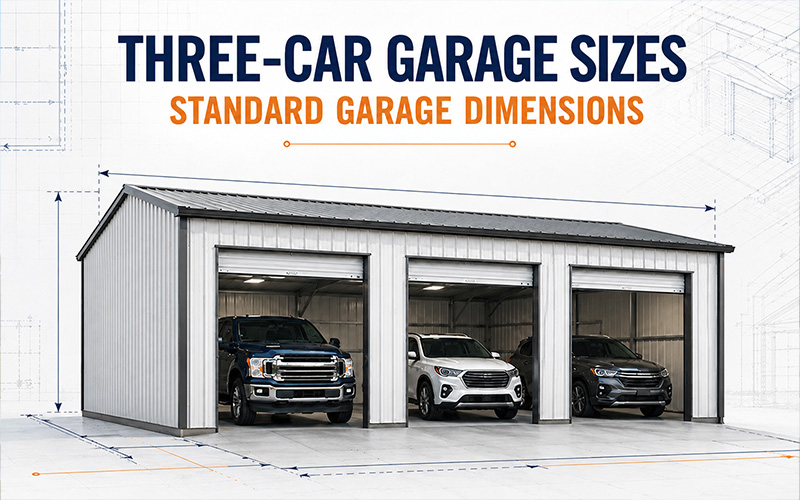
At Arkansas Metal Structures, one of the first things we tell customers is this: a three-car garage gives you a lot more flexibility, but only if the layout actually fits how you plan to use it.
A three-car garage is not just about fitting three vehicles under one roof. For a lot of Arkansas homeowners, one bay ends up holding a truck, another holds an SUV, and the third turns into storage, a mower bay, a side-by-side space, or a workshop corner. That is why size matters so much.
If the building is too tight, it stops being useful fast.
For most homeowners in the U.S., the three-car garage sizes people recognize most are:
30x20
30x24
32x24
36x24
36x30
Those are the sizes customers ask about most because they are familiar, practical, and easy to picture. Some work as a basic three-vehicle garage. Some give you room for storage and workspace without crowding the building.
What is a standard three-car garage size?
A standard three-car garage usually starts at 30x20.
That is the minimum size many people picture when they think of a three-bay garage. It can work if you are parking smaller vehicles and keeping the layout simple.
The problem is that 30x20 gets tight quickly.
Once you factor in door swing, walking room, shelves, tools, bins, mowers, or larger trucks and SUVs, the space starts feeling smaller than expected. That is why many homeowners move up to a deeper or wider layout before they build.
Common three-car garage dimensions and what they feel like
30x20 three-car garage
This is the starting point.
A 30x20 garage can fit three vehicles, but it usually feels tight if one or more of them is full-size. It works best when the goal is basic parking and not much else.
Best for:
three smaller vehicles
basic enclosed parking
compact layouts
homeowners trying to stay at the minimum size
30x24 three-car garage
A 30x24 garage gives you more depth. That changes the feel of the space right away.
You get easier parking, better walking room, and more flexibility at the front or back for shelves or storage.
Best for:
three daily drivers
a mix of cars and small SUVs
parking plus light storage
homeowners who want a more practical layout
32x24 three-car garage
A 32x24 garage gives you more side clearance. That matters if you want easier door opening or more breathing room between vehicles.
This size makes more sense for households with larger vehicles or anyone who wants the garage to feel less tight every day.
Best for:
trucks and SUVs
easier movement between vehicles
parking plus side-wall storage
homeowners who use the garage heavily
36x24 three-car garage
This is one of the most recognized and most comfortable three-car garage sizes.
A 36x24 garage gives you enough room for three vehicles and still leaves space to move around. It is a strong choice for homeowners who want a garage that feels useful, not packed.
Best for:
three larger vehicles
storage with the vehicle bays
cleaner day-to-day use
customers planning for long-term flexibility
36x30 three-car garage
A 36x30 garage gives you room to do more than park vehicles.
This size works well if you want one or two bays for parking and another area for tools, a workbench, a mower, a side-by-side, or household storage.
Best for:
workshop use
larger trucks or trailers
mixed storage and parking
customers who want extra space from the start
Typical three-car garage door setup
Most three-car garages use one of these door layouts:
three single garage doors
one double garage door and one single garage door
one wide door setup, though this is less common on a true three-car layout
Three single doors give you the cleanest separation between bays. A double-plus-single layout is also common because it balances the front of the building and keeps access simple.
The right setup depends on the building style, the vehicles, and how you want to use each bay.
Three-car garage types customers ask for most
At Arkansas Metal Structures, customers usually do not just ask for a size. They ask for a layout that matches how they live.
Here are some of the most common three-car garage types.
Three-car garage with three roll-up doors
This is one of the most common setups.
Three enclosed bays. Three overhead doors. Clear access for each vehicle.
Common sizes:
30x24
32x24
36x24
This works well for households with multiple daily drivers and a straightforward use plan.
Three-car garage with double door plus single door
This setup uses one larger two-car opening and one separate single opening.
Common sizes:
30x24
36x24
This layout works well when one side handles the main vehicles and the third bay stays more flexible.
Three-car garage with storage space
This type gives you room for three vehicles and still leaves wall or corner space for shelves, bins, tools, or household storage.
Common sizes:
32x24
36x24
This is one of the smartest layouts because storage starts filling empty space faster than most people expect.
Three-car garage with workshop space
This setup makes sense when the garage needs to do more than hold vehicles.
Common sizes:
36x24
36x30
If one bay is going to hold a workbench, tools, or hobby equipment, the extra square footage makes a big difference.
Three-car garage with lean-to
A lean-to adds covered space beside the enclosed garage.
This works well for trailers, mowers, firewood, a side-by-side, or outdoor gear that does not need to be fully enclosed.
Common setups:
30x24 garage with an 8- or 10-foot lean-to
36x24 garage with an 8- or 10-foot lean-to
For many Arkansas properties, this is a very practical setup because it adds more covered use without crowding the main garage.
What size should you choose?
The right size comes down to what is going inside and how you want the garage to feel after the vehicles are parked.
If you only need basic parking for three smaller vehicles, 30x20 may work.
If you want a more practical layout, 30x24 is usually a better place to start.
If you want room for larger vehicles, easier access, or storage, 32x24 or 36x24 usually makes more sense.
If you want workshop space too, 36x30 is a safer call.
Most customers who go too small feel it later. A few extra feet usually change how the whole building works.
What we tell customers before they order
Measure the vehicles first.
Then think about:
Door swing
Walking room
Shelf space
Mower or trailer storage
Future vehicle changes
A garage built around today’s vehicles may feel different later if one of them becomes a truck, a larger SUV, or a side-by-side. It is better to plan for that now.
Final thoughts
A three-car garage is not just about getting three vehicles under a roof. It is about how the building works once you start using it.
For most homeowners, the common U.S. sizes that make the most sense are 30x20, 30x24, 32x24, 36x24, and 36x30. A 30x20 handles the minimum. A 30x24 is more practical. A 32x24 or 36x24 gives you room to move, store equipment, and use the building without feeling boxed in. A 36x30 gives you even more flexibility if you want workspace too.
At Arkansas Metal Structures, we guide customers to the size that fits the way they live, not just the number of vehicles they own. That usually leads to a better building and fewer regrets later.